Why the Liturgical Calendar Matters for Genealogy
Anyone who has transcribed a Ukrainian parish register quickly discovers that dates alone do not tell the whole story. Priests writing in Galicia, Bukovyna, or a prairie Canadian mission often anchored events to the church calendar rather than, or in addition to, a numeric date: a child "born on the eve of Sviaty Vechir," a marriage performed "the week after Pokrova," a burial noted simply as occurring "on St. Nicholas's day." Without a working knowledge of the Ukrainian Orthodox feast calendar, these references are meaningless, and a researcher can easily misdate an ancestor's baptism by days or mistake a Julian-calendar date for a Gregorian one.
The liturgical calendar also shaped the rhythm of rural community life. Major feasts marked seasonal turning points for planting, harvest, and travel, and families frequently timed weddings and baptisms around them, both for convenience and for religious significance. Understanding which feasts fell when, and how Julian dating differs from the Gregorian calendar in everyday use, is a foundational skill for reading these records accurately. This guide builds on the context in our companion article on Ukrainian Orthodox church records in Canada, which covers where these registers are held and how to request them.
Calendar practice was not uniform. Some Ukrainian Orthodox parishes in Canada eventually adopted the Revised Julian calendar for fixed feasts while continuing to calculate Pascha using the older Julian method, whereas many Greek Catholic parishes shifted further toward the Gregorian calendar over the twentieth century. Always check which calendar a specific parish was using during the period you are researching.
Julian vs. Gregorian: Understanding the 13-Day Offset
The Julian calendar, introduced by Julius Caesar in 45 BC, calculates leap years slightly differently from the Gregorian calendar adopted by Catholic Europe starting in 1582. Because the Julian calendar adds a leap day more often than is astronomically necessary, it has gradually drifted behind the Gregorian calendar by a small amount each century. By the twentieth century — the period covering most Ukrainian emigration to Canada — this drift had reached a consistent 13 days.
In practical terms, a date recorded in a Julian-calendar parish register is 13 days "behind" the equivalent Gregorian, or civil, date used in Canadian government records, newspapers, and ship manifests of the same era. A baptism recorded as occurring on January 1 (Julian, "Old Style") corresponds to January 14 on the Gregorian calendar. This is precisely why Ukrainian Christmas, tied to the Julian December 25, falls on January 7 of the Gregorian calendar — a point explored further in our article on Ukrainian Christmas customs and cuisine.
Tip: If a parish register date and a civil record date for the same event are exactly 13 days apart, that is not an error — it almost certainly means one source used the Julian calendar and the other used the Gregorian calendar. Always note which calendar a source is using before treating a discrepancy as a transcription mistake.
The 13-day offset applies specifically to the twentieth century. Because the gap widens by roughly one day per century (at century turns not divisible by 400), eighteenth-century records show an 11-day offset and nineteenth-century records typically show 12 days. For the bulk of Ukrainian-Canadian immigration records, spanning roughly 1891 to the 1950s, the 13-day figure applies.
Converting Old Style and New Style Dates
Genealogical sources often label dates as "O.S." (Old Style, Julian) or "N.S." (New Style, Gregorian) to remove ambiguity. When converting a twentieth-century Old Style date to New Style, the rule is straightforward: add 13 days to the Julian date to arrive at the Gregorian equivalent. To convert in the opposite direction, subtract 13 days from the Gregorian date.
- Julian (O.S.) date + 13 days = Gregorian (N.S.) date, for events between 1900 and 2099
- Gregorian (N.S.) date − 13 days = Julian (O.S.) date, for the same period
- Watch for month-end rollovers: a Julian date late in a month may convert to the following month in the Gregorian calendar
- Always record both the source date as written and your calculated conversion, so future researchers can verify your work
Church registers maintained in Canada present a particular challenge, because some parishes recorded events using the Julian calendar even after the family had settled in a country that used the Gregorian calendar for all civil purposes. A Canadian-born child's baptismal entry might be dated Old Style in the parish register while the civil birth registration, if one exists, uses the Gregorian date. When two records appear to disagree by 13 days, the conversion rule above almost always resolves it. For guidance on reading the handwriting and abbreviations that often accompany these dates, see our resource on reading old Cyrillic church records.
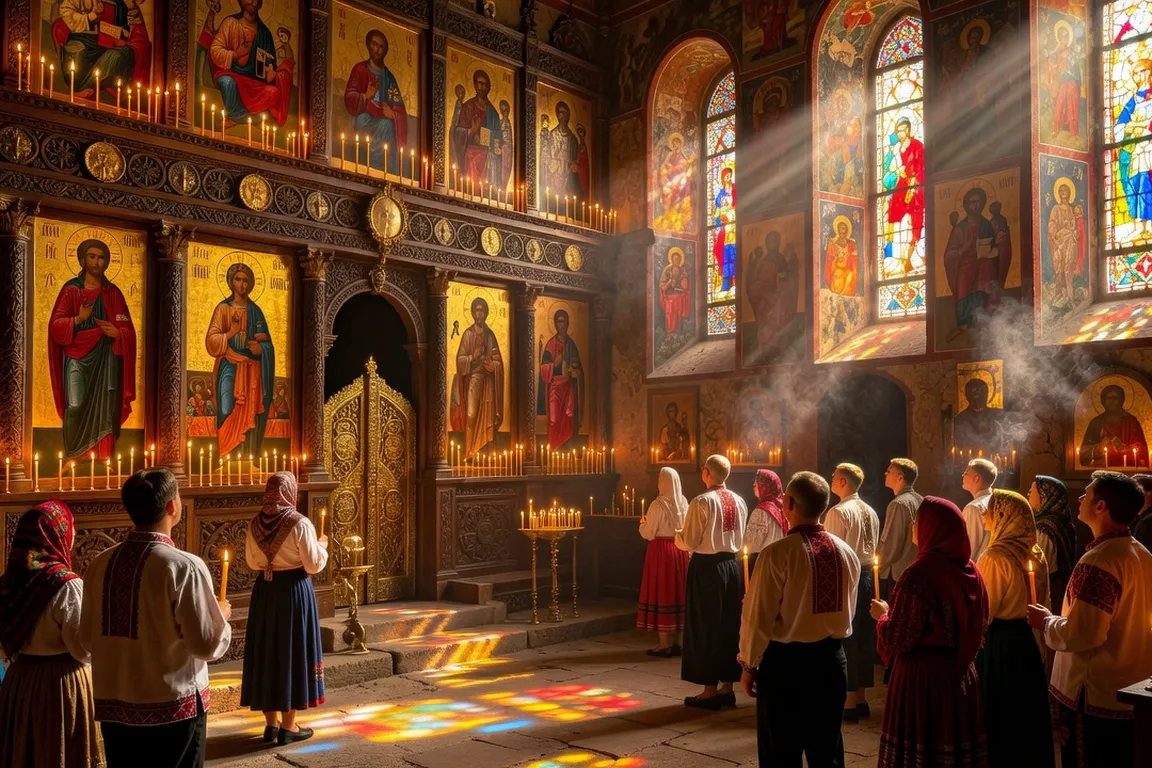
Major Feast Days of the Ukrainian Orthodox Year
The table below lists the principal fixed feasts of the Ukrainian Orthodox liturgical year, showing both the traditional Julian (Old Style) date and its Gregorian (New Style) civil-calendar equivalent for the twentieth century. These are the feasts most likely to appear as reference points in parish registers, family letters, and community history accounts.
| Feast | Julian Date (O.S.) | Gregorian Date (N.S.) | Genealogical Significance |
|---|---|---|---|
| Nativity (Ukrainian Christmas) | December 25 | January 7 | Common date cluster for baptisms and family gatherings |
| Theophany (Epiphany, Jordan) | January 6 | January 19 | Water blessing services often noted in parish diaries |
| Feast of St. Nicholas | December 6 | December 19 | Popular name-day and personal feast for men named Mykola |
| Annunciation | March 25 | April 7 | Marks the start of the liturgical spring cycle |
| Feast of the Protection (Pokrova) | October 1 | October 14 | Patronal feast for many prairie parishes; weddings clustered nearby |
| Dormition of the Mother of God | August 15 | August 28 | Major late-summer feast; harvest-season baptisms common |
| Feast of SS. Peter and Paul | June 29 | July 12 | Traditional end of the pre-harvest fasting period |
Christmas and Theophany carry the expected 13-day offset, but the gap can shift by a day depending on the exact century calculation and whether a parish had already switched to the Revised Julian calendar for fixed feasts. When in doubt, cross-check a specific year using one of the calendar tools described later in this guide.
Movable Feasts and the Paschal Cycle
Unlike the fixed feasts above, Pascha (Easter) and the feasts that depend on it move according to a separate lunar-based calculation, and Ukrainian Orthodox and Greek Catholic parishes traditionally computed this date using the Julian method — which frequently places Orthodox Pascha on a different Sunday than Western Easter, sometimes by several weeks. This is the same calculation discussed in more depth in our article on Ukrainian Easter traditions and pysanky.
Several other significant dates are calculated relative to Pascha and are worth recognizing when they appear in parish records:
- Palm Sunday, one week before Pascha, when many parishes recorded a surge of confessions and preparatory rites
- Bright Week, the week immediately following Pascha, traditionally a popular time for baptisms once the Great Fast had ended
- Ascension, forty days after Pascha, occasionally used as a reference point in land and property transactions noted alongside church business
- Pentecost (Trinity Sunday), fifty days after Pascha, historically a common wedding date once spring fieldwork had eased
Because the date of Pascha changes every year and does not follow a fixed offset, researchers cannot use the 13-day rule to calculate it. Instead, consult a Paschal calendar table or online Orthodox Easter calculator for the specific year in question before converting any entry that references "the week before Pascha" or similar movable-feast language.
How Feast Days Appear in Baptism, Marriage, and Burial Registers
Priests recording sacramental events frequently used feast-day language as a form of shorthand, particularly in rural parishes where the liturgical calendar was more familiar to the community than the civil one. A baptismal entry might read "born on the feast of the Dormition" rather than spelling out a numeric date, especially in registers kept before parishes standardized their record-keeping format in the early twentieth century.
| Register Type | Typical Feast-Day Reference | What It Tells the Researcher |
|---|---|---|
| Baptism | Birth or baptism "on" or "near" a named feast | Approximate date, useful when the numeric entry is faded or illegible |
| Marriage | Wedding scheduled around Pokrova or Peter and Paul | Confirms the marriage occurred outside a fasting period, when weddings were restricted |
| Burial | Death "on the eve of" a major feast | Helps narrow a death date when the register page is damaged |
This pattern is especially useful when a page has been damaged, water-stained, or partially illegible, which is unfortunately common in registers that survived difficult transport during emigration or decades of storage in rural church basements. A legible feast-day reference can establish a date range even when the numeric day has been lost. Cross-referencing these entries with our broader guide to Ukrainian church records and metrical books can help identify additional registers that preserve a corroborating entry.
Name Days, Feast Days, and Given Names
Many Ukrainian families followed the tradition of naming a child after the saint whose feast day fell on or near the child's date of birth, a practice that can help researchers cross-check a birth date against the liturgical calendar. If an ancestor is recorded as Mykola (Nicholas), for example, it is worth checking whether the birth or baptism date falls near December 6 (Julian) or one of the other feasts associated with St. Nicholas.
- A child born near the Feast of the Protection (Pokrova, October 1 Julian) was sometimes given the name Pokrovsky as a surname element in some regions, or the feast was noted as the reason for the given name Maria
- Boys born near June 29 (Julian) were sometimes named Petro or Pavlo, after Peter and Paul
- Girls born near a feast of the Mother of God were sometimes given the name Bohdana or Maria in reference to the occasion
This naming pattern is not universal and should be treated as a supporting clue rather than firm proof, but combined with a plausible feast-day reference in a register, it can strengthen confidence in an otherwise ambiguous entry.
Common Mistakes When Working With Calendar Dates
Calendar confusion is one of the most persistent sources of error in Ukrainian-Canadian genealogical research, and it is worth being deliberate about avoiding the following pitfalls.
Common mistake: Applying the 13-day Julian-to-Gregorian offset to a movable feast such as Pascha. The offset only applies to fixed feasts calculated from a set calendar date. Movable feasts must be looked up individually for each year using a Paschal calendar, never calculated with a flat day-count adjustment.
- Assuming every Ukrainian Orthodox or Greek Catholic parish in Canada used the same calendar throughout its entire history, when in fact individual parishes sometimes switched calendars mid-century
- Treating a feast-day reference as an exact date rather than an approximate one, when the priest may have meant "around the time of" rather than the precise day
- Confusing the Ukrainian Orthodox Pascha date with the Western (Roman Catholic or Protestant) Easter date, which frequently falls on a different Sunday
- Forgetting to note which calendar system a civil record (such as a ship manifest or provincial birth registration) used, since some early Canadian clerks recorded dates supplied verbally by Julian-calendar immigrants without converting them
When a date discrepancy appears between two otherwise reliable sources, checking first for a 13-day gap — or, for movable feasts, consulting a year-specific Paschal table — should be the first troubleshooting step before assuming either record is wrong.
Tools and Resources for Calendar Conversion
Several reliable references can help researchers convert dates and identify feast days with confidence. The Orthodox Church in America maintains a detailed online liturgical calendar that lists both fixed and movable feasts for any given year, which is useful for verifying Paschal-cycle dates that cannot be calculated with a simple offset. Consulting a resource such as the Orthodox Church in America's guide to the date of Pascha is a practical starting point for movable feasts, while general Julian-to-Gregorian date converters are widely available for fixed-date calculations.
Beyond online calculators, many published parish histories and diocesan yearbooks include a liturgical calendar appendix specific to the Ukrainian tradition, and these are worth requesting alongside any register search. Our overview of the top free Ukrainian genealogy websites and databases also lists several sites that include calendar conversion tools tailored to Eastern European research.
The liturgical calendar is not a side detail in Ukrainian-Canadian genealogy — it is the framework within which generations of parish clerks recorded the milestones of family life. Learning to move fluently between Julian and Gregorian dates, and to recognize the feasts that shaped a community's calendar, transforms cryptic register entries into precise, usable evidence.
Frequently Asked Questions
Most Ukrainian Orthodox and Greek Catholic parishes recorded sacramental events using the Julian calendar, which by the twentieth century ran 13 days behind the Gregorian calendar used for Canadian civil records, newspapers, and government registration. A single event can therefore appear with two different, both correct, dates depending on which calendar the source used.
For twentieth-century dates, add 13 days to a Julian (Old Style) date to find the equivalent Gregorian (New Style) date, and subtract 13 days to convert the other direction. This flat offset applies only to fixed feasts and dates; movable feasts such as Pascha must be looked up year by year using a Paschal calendar rather than calculated with a simple day count.
Priests in many rural Ukrainian parishes used feast-day language as shorthand for a date, especially when the liturgical calendar was more familiar to the community than the civil calendar. This can also be a helpful clue for the child's given name, since it was common practice to name a child after the saint whose feast fell on or near their birth date.
Not always, but frequently. Because Ukrainian Orthodox Pascha is calculated using the Julian method while Western Easter uses the Gregorian method, the two dates can align in some years and diverge by one to five weeks in others. There is no fixed offset for this movable feast, so each year's date must be checked individually.
No. Calendar practice varied by parish and denomination, and some congregations shifted to the Revised Julian or Gregorian calendar for fixed feasts over the course of the twentieth century while still calculating Pascha using the traditional Julian method. Always verify which calendar a specific parish was using during the period you are researching rather than assuming a single rule applies network-wide.