What Is Kolach? An Introduction to the Ukrainian Christmas Bread
Kolach (also spelled kolach or kolatch, from the Ukrainian kolo, meaning "circle") is the braided ceremonial bread placed at the centre of the Ukrainian Christmas Eve table, known as Svyata Vechera or "Holy Supper." Unlike an everyday loaf, kolach is built from several separate round braided rings stacked one atop the other, with a small candle set into the topmost ring. It is not eaten first, and in many households it is not eaten at all on Christmas Eve — its role that evening is symbolic rather than nutritional.
For readers already familiar with the broader Svyata Vechera meal, kolach is one dish among the traditional twelve, but it holds a uniquely central position. Our companion article on the twelve dishes of Svyata Vechera covers the full meal, while this guide focuses specifically on the bread itself: where the tradition came from, what each element represents, and how families continue to bake it today.
History and Origins of the Ritual Bread
Ritual breads occupy a central place across Slavic folk custom, and kolach is part of a much older tradition of round, braided breads used to mark significant life events — births, weddings, harvests, and death anniversaries — long before Christianity arrived in Kyivan Rus'. The circular shape itself predates any specific religious meaning, originally standing in folk custom for the sun, the yearly cycle, and the unbroken continuity of a family line.
When Christianity took root in Ukraine after the baptism of Kyivan Rus' in 988, existing seasonal and ancestral customs were gradually layered with Christian meaning rather than replaced outright. The winter solstice bread became associated with the Nativity, and the circle came to represent eternity and the Holy Trinity. By the time detailed ethnographic descriptions of Ukrainian village life were recorded in the nineteenth century, kolach was already a fixed, essential feature of the Christmas Eve table across Galicia, Bukovyna, Podillia, and the central Ukrainian lands — the very regions from which most Ukrainian-Canadian settlers emigrated between 1891 and the 1920s.
Families who arrived on the Canadian prairies and, later, in communities such as those on Prince Edward Island carried this bread-baking tradition with them, adapting it to available flour, ovens, and household routines while preserving its essential form and meaning. The kolach baked in a Manitoba farmhouse kitchen in 1905 and the kolach baked in a PEI kitchen in 2026 follow largely the same structure, a continuity that genealogists researching Galicia-to-Canada migration often find reflected in family recipe notebooks passed down alongside baptismal certificates and homestead papers.
Symbolism: The Trinity, the Candle, and the Circle of Life
Nearly every visual element of the kolach carries deliberate meaning, built up over generations of practice. Understanding these details transforms the bread from a simple centrepiece into a small, edible catechism of family and faith.
- Three stacked rings: The most widespread interpretation holds that the three braided rings represent the Holy Trinity — Father, Son, and Holy Spirit — stacked to show their unity.
- The circular shape: Each ring is a closed loop with no beginning or end, symbolizing eternity, the eternity of God, and the unbroken continuity of the family across generations.
- The central candle: A single candle placed in the top ring represents the Star of Bethlehem and the light of Christ entering the world; in some regional customs it is also described as a light guiding the souls of deceased ancestors back to the family table.
- An empty place setting nearby: Though not part of the bread itself, kolach is traditionally set beside an extra place at the table, reserved for ancestors who have died and, in some households, for any traveller who might arrive that night.
- The braid pattern: The interwoven strands of dough are sometimes described as representing the interconnectedness of family members, each strand distinct yet inseparable from the whole.
Did you know? In many households the number of rings has historically varied — some regional customs stack only one or two, while others use three specifically to emphasize the Trinity. There was never a single universal standard; the meaning mattered more than a fixed rule, and village-to-village variation was common even within a single province of Galicia or Bukovyna.
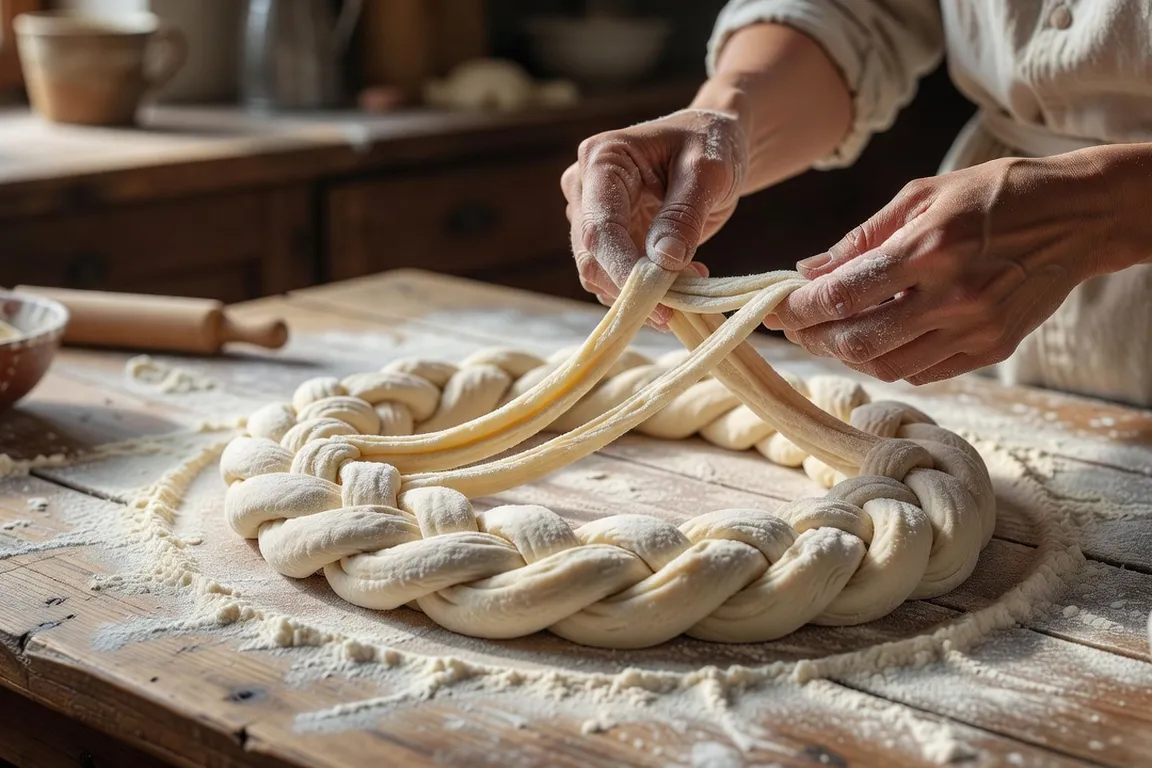
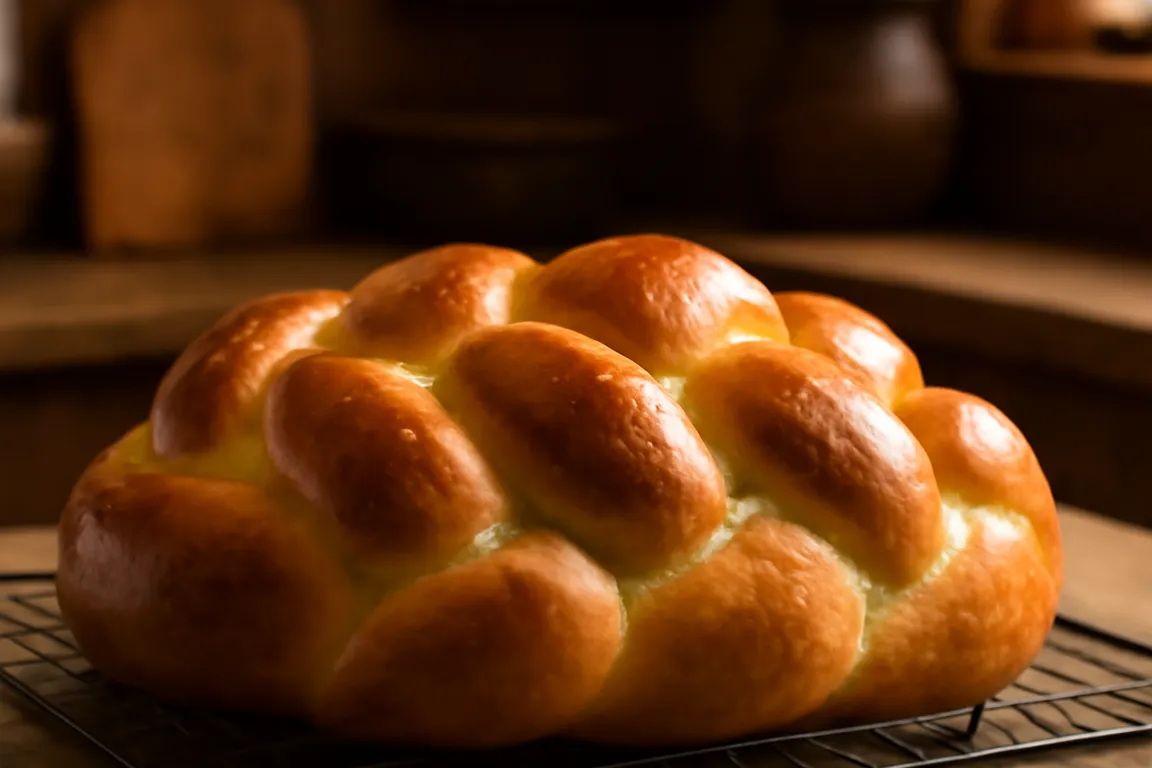
Traditional braided Ukrainian kolach Christmas bread with three stacked rings and a lit candle on a rustic wooden table.
This layered symbolism is why kolach, more than almost any other dish on the Svyata Vechera table, is often the first tradition a family teaches to children and grandchildren. Learning to braid the dough correctly becomes, in a small way, a lesson in the household's faith and its sense of continuity with those who came before. For readers researching how these customs fit into the wider pattern of Ukrainian Christmas observance, our overview of Ukrainian Christmas customs and cuisine situates kolach within the full evening's rituals, from the appearance of the first star to the twelve meatless dishes served afterward.
A Traditional Kolach Recipe
Kolach dough is a simple, enriched yeast dough — not unlike a mild challah or brioche in texture, though traditionally less sweet and less buttery than either. The technique lies almost entirely in the braiding and stacking rather than in unusual ingredients.
The list below reflects ingredients commonly used in Ukrainian-Canadian households, drawn from long-standing family practice rather than any single fixed formula:
- 4 to 5 cups all-purpose flour
- 1 packet (about 2¼ teaspoons) active dry yeast
- 1 cup lukewarm milk
- 2 to 3 tablespoons sugar
- 1 teaspoon salt
- 2 eggs, plus 1 extra egg yolk for the egg wash
- 3 to 4 tablespoons melted butter or vegetable oil
- A pinch of saffron or a few drops of vanilla (optional, for colour and aroma in some regional versions)
To prepare the dough, the yeast is first proofed in the warm milk with a spoonful of the sugar until foamy, then combined with the flour, remaining sugar, salt, eggs, and melted butter. The dough is kneaded until smooth and elastic, then left to rise until doubled, typically about an hour in a warm kitchen. Once risen, the dough is divided into three unequal portions — the largest for the bottom ring, a medium portion for the middle, and the smallest for the top ring that will hold the candle.
Each portion is further divided into three or four ropes of dough, which are braided and then joined end to end to form a closed ring. The rings are left to rise a second time before being brushed with egg wash and baked at a moderate oven temperature, usually around 350°F (175°C), until deep golden brown and hollow-sounding when tapped. Once cooled, the three rings are stacked, largest at the bottom, and a small votive or taper candle is secured in the centre of the top ring just before the meal begins.
Common mistake: Over-baking the rings in an attempt to make them extra crisp for stacking. Kolach rings should remain tender inside; an overly hard, dry crust makes the loaves difficult to slice for eating afterward and can cause the top ring to crack under the weight of the candle holder.
The Ritual: How Kolach Is Used During Svyata Vechera
The presentation of kolach follows a fairly consistent sequence in most Ukrainian-Canadian households, even though small family variations exist. Understanding the order helps explain why the bread is treated with such ceremony rather than simply served alongside the other eleven or twelve dishes.
- The kolach is placed at the centre of the table before the meal begins, often on a decorative embroidered cloth (rushnyk).
- The head of the household lights the candle set into the top ring once the first star appears in the evening sky, marking the formal start of Svyata Vechera.
- A short prayer or blessing is offered, sometimes accompanied by the traditional Christmas greeting "Khrystos Rodyvsya" ("Christ is Born"), answered with "Slavimo Yoho" ("Let us glorify Him").
- The kolach remains at the centre of the table, unbroken, throughout the entire twelve-dish meal as a visual anchor and reminder of the meal's sacred purpose.
- In many families, the bread is only cut and shared the following day, or portions are set aside for those unable to attend, including a symbolic portion left for departed family members.
This sequence reinforces why kolach functions differently from the other dishes on the table. While dishes such as kutia, borscht, and varenyky are eaten as part of the meal itself, kolach's primary role that evening is to be present, lit, and witnessed — a visible expression of faith and family continuity rather than simply a food to be consumed.
Ukrainian-Canadian family gathered around a table with lit kolach bread during Svyata Vechera Christmas Eve supper.
Regional Variations of Kolach and Related Ritual Breads
While the three-ring, candle-topped kolach is the form most commonly described in Ukrainian-Canadian households today, ritual breads with similar names and functions vary across regions of Ukraine and among neighbouring Slavic cultures. The table below outlines some of the more commonly noted variations researchers and home bakers may encounter.
| Bread / Tradition | Region or Culture | Distinguishing Feature |
|---|---|---|
| Kolach (three-ring, candled) | Western Ukraine (Galicia, Bukovyna) | Three stacked braided rings with central candle, most widely known form |
| Kolach (single ring) | Some central Ukrainian villages | One large braided ring, sometimes without a candle, used more simply as a table centrepiece |
| Krendel | Broader Eastern Slavic tradition | Pretzel-shaped ritual bread, more associated with name-day and welcome customs than Christmas specifically |
| Kolač (Serbian/Croatian) | South Slavic Orthodox and Catholic communities | Related name and round shape, but used primarily for Slava (patron saint) celebrations rather than Christmas Eve |
| Karavai | Ukrainian and broader Slavic wedding custom | Similarly braided and decorated bread, but built for weddings rather than Christmas |
These related breads share visual and technical similarities — braiding, a round or ring shape, decorative dough elements — because they emerge from the same broader Slavic tradition of ritual bread-baking for life's major milestones. The Christmas kolach is distinguished chiefly by its stacked, candled form and its specific placement within the Svyata Vechera ritual described above.
It is also worth noting that regional dialect and family habit sometimes apply the word "kolach" loosely to other braided breads served during the same season, including smaller individual braided rolls given as gifts to carollers on Christmas Day itself, distinct from the large centrepiece loaf used on Christmas Eve. Readers wanting a deeper ethnographic account of Ukrainian ritual bread traditions can consult the Ukrainian Museum of Canada, which documents folk customs, textiles, and foodways brought by early Ukrainian settlers, and the Internet Encyclopedia of Ukraine, a scholarly reference for Ukrainian folk custom and religious practice.
Common Mistakes When Baking or Understanding Kolach
Because kolach carries both a culinary and a symbolic role, confusion tends to arise on both fronts — in the kitchen and in how the tradition is explained to younger family members or researched by those reconstructing family customs.
Common mistake: Treating kolach as identical in every Ukrainian household. Because the tradition was carried by families from many different villages and regions and adapted over more than a century in Canada, the number of rings, the exact dough recipe, and even the timing of when the bread is finally eaten can differ meaningfully from one family to the next. There is no single "correct" version to compare a family recipe against.
Beyond that central misunderstanding, a few practical issues come up repeatedly among home bakers attempting the recipe for the first time:
- Using dough that is too wet or under-kneaded, which causes the braided rings to lose their shape and spread flat during baking rather than holding a defined ring form.
- Stacking the rings while still warm, which can cause the upper rings to slide or the whole structure to collapse before the candle is lit.
- Placing the candle directly on the dough surface without a proper holder, creating a fire hazard as the candle burns down during the meal.
- Assuming the bread must be eaten immediately, when in many family traditions it is deliberately left uncut until the following day or a later feast day.
Kolach in Ukrainian-Canadian Family Traditions Today
More than a century after the first wave of Ukrainian settlers arrived in Canada, kolach remains one of the most consistently preserved elements of Christmas Eve custom in Ukrainian-Canadian households, including communities far from the original prairie bloc settlements. Its persistence says something notable about which traditions survive across generations and migrations: rituals with clear, repeatable physical actions — braiding dough, lighting a candle, setting a place for the departed — tend to endure even as language use and other customs fade.
For families researching their own Ukrainian-Canadian heritage, the kolach tradition can also serve as a useful genealogical thread. Recipe notes passed down through a family, or memories of who traditionally baked the bread each year, often connect to a broader pattern of parish and community life recorded in the kinds of records described in our guide to Ukrainian Orthodox church records in Canada and in the parish histories covered in our article on Ukrainian Orthodox and Greek Catholic parish history in Canada. A family that maintained its kolach tradition carefully often also maintained ties to a specific parish community, offering researchers another avenue of inquiry when written records are incomplete.
Whether baked from a handwritten recipe card inherited from a grandmother in Galicia or Bukovyna, or learned more recently from a community cookbook or parish cooking class, the kolach on a Ukrainian-Canadian Christmas Eve table in 2026 continues to carry the same layered meaning it held in village kitchens more than a century ago: faith, family continuity, and a quiet, edible reminder that no one sits at that table entirely alone.
Frequently Asked Questions
Kolach is most commonly understood as symbolizing the Holy Trinity through its three stacked rings, eternity and continuity through its circular shape, and the light of Christ or a guide for departed ancestors through the candle placed at its centre. The exact interpretation can vary somewhat from family to family and region to region.
The candle is generally understood to represent the Star of Bethlehem and the light of Christ entering the world. In some regional folk customs it is also described as a light meant to welcome the souls of deceased family members back to the table for the Christmas Eve meal.
Practice varies by family. In many households the kolach remains uncut and simply displayed as a centrepiece throughout the Svyata Vechera meal, with the bread cut and eaten the following day or over the following days of the Christmas season, sometimes with a portion symbolically set aside for absent or deceased family members.
Three stacked rings is the most widely recognized form, generally associated with the Holy Trinity. However, historical and regional practice was never fully standardized, and some village and family traditions used a single ring or other variations, so a family's own custom should be treated as valid on its own terms.
Kolach is the ritual bread associated specifically with Christmas Eve and Svyata Vechera, typically formed as stacked braided rings with a candle. Korovai (also spelled karavai) is a related but distinct ritual bread, usually larger and more elaborately decorated, made for weddings rather than Christmas. Both emerge from the same broader Slavic tradition of ceremonial braided breads.